Showing posts with label NEWS. Show all posts

Sunday, July 8, 2018

   
Putin Is Preparing a Deal Trump Can Tout After Summit

Putin Is Preparing a Deal Trump Can Tout After Summit


(Bloomberg) -- Kremlin officials are in intense negotiations with their counterparts in Washington to strike at least one deal they hope will let President Donald Trump tout his summit with Vladimir Putin as a triumph that justifies steps to repair relations.
At the top of the list for the July 16 meeting in Helsinki, Finland, is Iran’s role in Syria, an issue that Moscow is simultaneously negotiating with Tehran, a senior Russian official said on condition of anonymity because he’s not authorized to comment on the record.
Putin has agreed in principle to U.S. and Israeli demands that Iranian-backed forces in southern Syria be kept away from Israel’s border, replaced with troops loyal to the government in Damascus, two Kremlin advisers said.
After studying Trump’s meeting with North Korean leader Kim Jong Un, during which he announced a surprise halt to U.S. military exercises with South Korea, Putin decided he needs to negotiate with the billionaire personally, the senior official said, without elaborating. The two leaders may meet without aides, as Trump and Kim did in Singapore, Kremlin spokesman Dmitry Peskov said.
One-On-One
U.S. Ambassador to Russia Jon Huntsman confirmed plans for a one-on-one meeting during a conference call on Thursday, saying Trump will go into the encounter with his “eyes wide open” about Putin’s intentions.
Trump has shifted away from his predecessor’s policy of demanding the ouster of Syrian leader Bashar al-Assad, a position formulated before Russia turned the tide of the country’s civil war in Assad’s favor with Iran’s help. U.S. National Security Adviser John Bolton, who met with Russia’s recently re-elected president to lay the groundwork for the summit, told CBS News on Sunday that Assad is no longer “the strategic issue” in Syria -- Iran is.
“We’ll see what happens when the two of them get together,” said Bolton, who’s long advocated regime change in the Islamic Republic. “There are possibilities for doing a larger negotiation on helping to get Iranian forces out of Syria and back into Iran, which would be a significant step forward.”
The first extended meeting between the two presidents is being viewed in Russia as an opportunity to turn a new page in relations that have plunged to rock bottom over a host of issues. They include the war in Syria and the sanctions imposed on Russia for its alleged election meddling, its annexation of Crimea and support for secessionists in Ukraine.
The summit, if successful, could boost the likelihood of sanctions de-escalation, Citigroup said in a research note.
Major Questions
Still, there are major questions about Putin’s ability to enforce any agreement involving Iran’s actions in Syria, even if he offers to deploy troops to stabilize the border areas in question. This in turn is fueling concerns in Washington and among U.S. allies in Europe that Trump may proclaim the Helsinki meeting a breakthrough without extracting any real concessions.
Trump trumpeted Kim’s vague pledge to “denuclearize” as a major victory for world peace, yet reports by researchers and media organizations have since detailed North Korean efforts to boost nuclear fuel production, build more missile launchers and expand a key rocket-engine plant.
Russia may have supplanted America as the indispensable arbiter in various Mideast conflicts but there’s only so far Putin is willing to go to appease Trump when it comes to Iran, according to Andrei Kortunov, head of the Russian International Affairs Council, a research group set up by the Kremlin.
“Trump can’t force Putin to turn away from Iran,” Kortunov said. “Putin is not willing to push Iran too hard and he cannot rely on Trump.”
Russia isn’t trying to take decisions with the U.S. about a third country behind its back, Putin’s spokesman, Dmitry Peskov, told reporters on a conference call on Friday, when asked about a possible deal on Iran’s presence in Syria.
Lavrov, Pompeo
Russia and Saudi Arabia have already irked Iran and pleased Trump by agreeing to roll back some of the cuts oil producers introduced to boost flagging prices. At the same time, Russia is also working to salvage the Iranian nuclear accord that Trump abandoned and mitigate the sanctions he’s reimposed. The foreign ministers of Russia, China, France, Germany and Britain met to discuss the issue with Iranian officials Friday in Vienna.
Russian Foreign Minister Sergei Lavrov said Wednesday that he’ll confer with U.S. Secretary of State Mike Pompeo after the Helsinki summit about implementing whatever agreements are reached. Even so, he cautioned that “it’s absolutely not realistic” to demand Iran pull out of Syria altogether.
“As in any other part of the world, you have to start by sitting down at the negotiating table, lay out your concerns and talk about how to resolve them on a mutually acceptable basis,” Lavrov told reporters in Moscow.
Pressure Point
After seven years of grinding conflict, Iran and proxy forces including Hezbollah have built up a formidable presence along Syria’s borders with Israel and Lebanon. That’s drawn repeated missile strikes from Israel and threats of further action, which Russia is using to pressure Iran, according to Dmitri Trenin, head of the Carnegie Moscow Center.
While Russia and Iran have been on the same side, backing Assad against rebels armed by the U.S. and its allies, their interests are now diverging as Putin seeks to secure his gains with regional backing, said Trenin, author of the 2017 book: “What Is Russia Up To in the Middle East?”
Israeli Prime Minister Benjamin Netanyahu is scheduled to meet with Putin in Moscow next week for the second time in as many months. This follows a visit to the Russian capital last month by Lebanese Prime Minister Saad Hariri. Russia backs a plan to replace Hezbollah fighters entrenched on the Syrian side of the border with Lebanon, said Elena Suponina, a Middle East expert in Moscow. That’s part of efforts to encourage several million Syrian refugees in neighboring countries to return home.
‘Take Control’
“Russia wants to see the Syrian government take control of as much territory as possible,” Suponina said.
Putin’s shifting positions on Syria and oil have angered officials in Tehran, according to Ali Khorram, a former Iranian ambassador to the United Nations.
“Russia has not only stabbed Iran in the back when it comes to Syria, but also voluntarily announced its readiness with Saudi Arabia to push Iran’s quota out of OPEC,” Khorram wrote in the Arman daily newspaper.
Putin’s strategy is to try and find a middle ground between the conflicting interests of major players. In particular, he may give Israel a green light to bomb any Iranian convoy that tries to deliver advanced weaponry to Hezbollah while also allowing Iran to maintain shipments of conventional arms to its Lebanese proxy forces, according to Kortunov, the Kremlin adviser.
For Iran, the overriding goal is to maintain its influence inside Syria and keep supply lines open, said Ehud Yaari, an Israel-based fellow at the Washington Institute.
“Russia has an interest to bleed Iran in Syria, to weaken Iran but not collapse Iran because it may lose the Assad regime, which is its major card,” said Sami Nader, head of the Levant Institute for Strategic Studies in Beirut. “They want Iran in check and under control.”
   
North Korea may have offered its clearest view yet of denuclearization

North Korea may have offered its clearest view yet of denuclearization


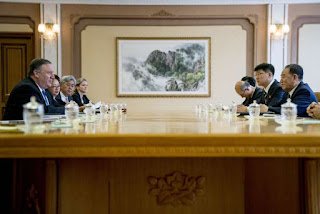
If Secretary of State Mike Pompeo’s visit to North Korea on Friday and Saturday was designed to ease worries about the progress on denuclearization talks between Washington and Pyongyang, it seems to have failed.
Just hours after Pompeo left the North Korean capital and described the negotiations as “productive,” North Korea’s Foreign Ministry released a scathing statement that cast the entire endeavor in doubt.
“The U.S. side came up only with its unilateral and gangster-like demand for denuclearization,” the statement said, adding that the American attitude toward the talks had been “regrettable.”
But North Korea’s statement itself was notable for far more than just its negative tone. Running more than 1,200 words in an official English-language translation released on the state-run Korea Central News Agency, it may offer the most comprehensive signal yet of how Pyongyang views the possibility of abandoning its nuclear weapons.
This vision will not shock seasoned North Korea-watchers, who say that Pyongyang has been largely consistent on the nuclear issue over the years. But it may come as a surprise to those who heard President Trump when he said that there was “no longer a nuclear threat from North Korea” a day after he met with North Korean leader Kim Jong Un for the first time in Singapore.
Pyongyang is now emphasizing that it views the brief, 400-word agreement reached at that summit as just the very beginning of talks, not a promise to unilaterally disarm.
“They undoubtedly see this as the first stage in a phase-by-phase, step-by-step simultaneous approach leading to denuclearization,” said Joel Wit, a former State Department official who helped negotiate a 1994 nuclear agreement with North Korea.
Indeed, the wording of North Korea’s statement may also suggest that it viewed the four items in the Trump-Kim agreement as a schedule. Denuclearization was the third item on the list. The first item was to establish “new U.S.-DPRK relations,” followed by efforts to build “a lasting and stable peace regime on the Korean Peninsula.” The statement released by Pyongyang on Saturday said that the “first process of defusing tension” would be to announce an official end to the Korean War.
But the North Korean Foreign Ministry complained Saturday that Pompeo’s team had “never mentioned the issue of establishing a peace regime on the Korean peninsula” while they were in Pyongyang. Instead, the statement said, the United States had continued its calls for “CVID”: complete, verifiable and irreversible denuclearization. That term has been repeatedly used by Pompeo and other U.S. officials to describe Washington’s aims in its talks with Pyongyang, though the State Department recently began using another term in its official statements: final, fully verified denuclearization.
North Korea highlighted what it saw as a major concessions on its part — the destruction of nuclear testing site Punggye-ri in May and the planned dismantling of a test facility for intercontinental ballistic missiles that it said would mark a “physical verification” of a freeze on missile production.
Vipin Narang, an expert on weapons proliferation at Massachusetts Institute of Technology, said the latter detail was particularly notable. “They view the test site as a bigger concession than it’s getting credit for,” Narang said. He noted that regional allies like Japan may be concerned that only long-range missiles were included.
The statement also implied that these moves were greater than the United States’ suspension of joint military exercises with South Korea, which it said was “a highly reversible step which can be resumed anytime at any moment as all of its military force remains intact.”
Such comments made clear that North Korea was ultimately seeking the removal of U.S. troops from the Korean Peninsula, according to Duyeon Kim, a fellow at the Korean Peninsula Future Forum.
“The North has never seen denuclearization in a vacuum, but as part of a larger package and something that’s considered only after there is a peace regime,” said Kim. “In other words, after U.S. troops are withdrawn and U.S.-South Korean military exercises are . . . abolished.”
While the statement did leave the door open for further talks, it may be setting the tone for going forward. Bruce Klingner, a former CIA analyst and North Korea expert at the Heritage Foundation, said the statement showed that to North Korea, denuclearization of the Korean Peninsula means “global arms control in which it will abandon its arsenal when all other nuclear powers, including the United States, abandon theirs.”
The United States may not ultimately agree to North Korea’s goals, but Wit and others said that talks should continue. Suggesting that the United States needed to find a special negotiator to meet continuously with the North Koreans, Wit said that it was “a fantasy to think that this can be done overnight” but that it could be done eventually.
Right now, North Korea appears to believe so too. For all the harsh language in the Foreign Ministry’s statement on Saturday, it remained respectful of one man whose views of the negotiations are really crucial.
“We still cherish our good faith in President Trump,” the statement read.
   
Executive Order: Knocks, Kudos for Buhari

Executive Order: Knocks, Kudos for Buhari


It’s tool to injure opposition – babatope
motion unknown to charter – attorneys
president acted constitutionally – sagay, junaid muhammad
desmond mgboh (kano), omoniyi salaudeen, onyedika agbedo (lagos)

remaining thursday’s signing by way of president muhammadu buhari of the executive order no. 6 of 2018 at the maintenance of belongings related with serious corruption and different relevant offences has generated heated arguments amongst eminent legal professionals and different nigerians.

whilst a number of them trust the president desires to usurp the powers of the country wide assembly to make laws for the u . s . with the aid of the usage of the govt order to strengthen the anti-corruption campaign of his administration, others suppose in any other case.

some of the attorneys who spoke with sunday solar on the issue maintained that most effective the country wide meeting (nass) is empowered to make legal guidelines for the usa, stressing that there are already enough laws that might be used to prosecute the battle against corruption.

they also raised concerns on the applicability of the government order, elevating the alarm that the executive should abuse it.

the executive order seeks to restrain owners of belongings under research from sporting out any in addition transaction on such property.

with the coming into effect of the order, president buhari hopes to swoop on the belongings stated to have been corruptly received at home and abroad via pinnacle authorities officials without delay and thru their fronts in and outdoor authorities through the years.

searching at the brand new order, the second one vp of the nigerian bar affiliation (nba), monday onyekachi ubani, advised sunday sun that the 1999 charter has no provision for govt orders, which has the pressure of law.

he said: “underneath our laws, i don’t think there's any provision that announces the president can trouble an government order, which has the force of regulation. in our democracy, if there may be any coverage or some thing that the president desires to have the force of law, he have to take that precise remember before the country wide meeting for proper enactment after which it will become a regulation. government orders are just like resolutions; their binding pressure is something that needs to be interrogated. we must have the ability to test these things in courtroom. the first-rate aspect to do is that if the president now desires to rule through govt orders, bypassing the national assembly, folks that are worried should deliver this be counted earlier than the judiciary to realize whether such executive orders have the force of regulation.”

ubani, who chairs the committee on get entry to to justice, judiciary and electoral procedure at the african bar affiliation, expressed his assist for the conflict towards corruption, however noted that the guideline of law must be followed in handling problems of corruption.

“i'm not against the combat towards corruption. however we've a constitution where recognize to rights is furnished, such as proper to own property, proper to liberty and all that. those are constitutional rights.

so, if constitutional rights do exist, there may be no other regulation let alone government order that may get rid of that proper. so, if each person is suspected and has now not been convicted and also you freeze his account or seize his property, then this is some other factor we need to test.”

he stated that there are extant laws inside the united states, which permit for the transient forfeiture of property suspected to be proceeds of crime and puzzled why the president needed to trouble the executive order.

“the reality today is if all of us is accused of crime underneath the efcc and icpc acts, his property can only go through what we call meantime forfeiture pending the time he's convicted. with a purpose to suffice, so i don’t understand the reason of this government order. is it trying to replace the enactment of sizeable laws with the aid of the legislature? is it looking to resource those already in existence through making ancillary provisions for them? so, we want to recognize the context underneath which the government order changed into made. laws are laws; executive orders are govt orders; constitutional rights are constitutional rights. now, the location of the regulation is that constitutional rights can not be taken away through any regulation let alone government order. within the ranking of laws, the constitution is number one, countrywide assembly act is quantity two; executive order isn't always legislative order. so, for anything it's far, it can not rank over legislative acts. an executive order cannot run advanced to the enactment of an act. it can't additionally run opposite to a constitutional proper,” he said.

talking inside the equal vein, attorney and human rights activist, malachy ugwumadu, said there is enough criminal legislation and method to deal with cases of corruption in the country, caution that the govt order may be abused.

he said: “i recognise and well known that a main plank of this administration is the combat in opposition to corruption. indeed, they rose to electricity at the crest in their avowal to address corruption head on. pursuant to that, the president has taken proactive steps, which include issuing executive orders. but the government need to critically continue to be circumspect in adopting such an method if we're decided to exercise constitutional democracy. i make my point clear by using announcing that there is enough prison law and manner to cope with what the president has come out with as government order.

“first and predominant, the idea of an government order, if abused, amounts to extreme usurpation

of the legislative powers of the national meeting. now, there may be the interim forfeiture act, via which you could immediately arrest and forfeit quickly property that are suspected to be proceeds of a criminal offense pending the dedication of a depend. so, an executive order, which in a experience encroaches at the legislative powers of the parliament and additionally expands the govt powers of the government to include legislative powers, creates a shape of diarchy that obtains only in army regimes.

“now, to what extent should such an government order, which isn't a regulation, be liable to abuse

if it is especially going to depend upon the suspicion of a government that is already wired for corruption investigation? it can be abused within the feel that it is able to be carried out towards men and women you don’t like.

it may be applied in opposition to persons with whom you've got one awl or the opposite to grind; it may be implemented in opposition to people who're just sufferers of wrong suspicion; it may additionally be implemented against folks who are actually corrupt, but those human beings cannot be declared corrupt via the govt. if we're practicing constitutional democracy, those people must be stated as corrupt via a court docket of law.

“i'm totally in assist of the combat against corruption. however there are problems of right. if i don’t such as you, i'd rely upon this executive order, which does no longer encompass that you ought to go to court, to deprive you of your belongings. so, the point is that there are already sufficient legislation and prison techniques so that it will allow this authorities to acquire the same cause without resorting to legislative usurpation of the powers of the country.”

the chairman, presidential advisory committee on anti-corruption, prof itse sagay, talking in defence of the president in a cellphone interview with sunday sun, said the order is in step with phase 5 of the constitution.

his words: “this is part of the president’s govt powers under segment five of the constitution. and the executive order isn't directed at any specific asset right now. what it does is to present the president the power to freeze any asset of every person who's being attempted or being interrogated or suspected of corruption or any fund, that's illicitly acquired pending the choice of the excessive courtroom or pending the lack of ability of the person to set up ownership. so as words, he doesn’t certainly seize them completely; it clearly creates a brief seizure pending the final outcome of the judicial processes.”

he, consequently, brushed off the worries being raised by means of a few stakeholders that the strength might be used to muzzle up the competition.

“it only pertains to belongings that have been illicitly or suspected to were illicitly or fraudulently received. if every person has a smooth hand, why need to he be afraid? it's far most effective the ones who have illegally accrued state belongings for themselves who have to be apprehensive by using this directive. in any case, the strength is already there beneath diverse laws – efcc law, icpc regulation, cash laundering act. the power is already there for the authorities to invite that belongings ought to be quickly frozen pending the overall process, which determines whether it's been legitimately acquired or not. the simplest distinction is whilst the court makes a temporary order of freezing or forfeiture in the efcc, icpc and money laundering act tactics, in this precise case, it is the president that gives the temporary order. a situation where some thing isn't always finished urgently, the belongings might have been offered, transferred or interfered with in a way that reduces their values in order that at the stop of the problem, what the government can recover could be less than what has been fraudulently received. this is the entire essence of the concept,” he explained.

asked whether or not the time is auspicious for such directive, sagay quipped: “so, if you don’t suppose

of some thing right away, you have to abandon it all the time. now, he has considered it important to use the energy. and if you read his reasons, he is calling at the risks of these illicit price range being to be had to those who have fraudulently acquired them. they are able to use them to intimidate prosecution, they could use them to sell crimes, they are able to use them to destabilise society, they can use them to reason adversity. very many terrible things may be completed with such unlawful and illicit property to be had to people who are suspected of frauds. that he didn’t think of it earlier than does now not suggest he can not use it. whatever can be performed in lifestyles of an administration. he's just including additional ammunition inside the combat in opposition to corruption, having concluded that the weapons we've got now need to be fortified.”

additionally speakme, second republic lawmaker, dr junaid muhammad, threw his weight at the back of the order. he said: “first and essential, if we take delivery of that corruption is a major hassle, a country wide problem and, in reality, an existential hassle for the complete united states, i don’t see any purpose this govt order ought to now not be general by means of nigerian.

“in truth, the question ought to be why did it take so long for them to invoke this govt order. they need to have invoked this order a totally long time ago. but now that it's miles carried out, i think that we would say that it is better past due than by no means.

“wide variety two, some of humans get stressed about what they name proper to lifestyles, to assets and so forth and so forth. the reaction is that once any person has been taken in and is being investigated and some of the substances which he received as a result of corruption, i assume these property ought to be frozen.

i don’t think that their being frozen could change the final results of the investigation. of route, as soon as it's far confirmed that corruption become concerned in the purchase of those belongings, investments and what have you, i suppose a law need to be supplied to continue with the case in order that they will be seized. but in the intervening time, i assume we're talking about freezing a number of those property so that they do now not stay in limbo with no one understanding their fame. and the proprietors may additionally have died or had been despatched to jail, you start to surprise what is the fame of some of those property which have been obtained corruptly or which got here to light because of investigation by using a able frame like the financial and monetary crimes fee. i am in absolute support of the government order.”

on the timing of the order, he introduced: “i should say that the question of the timing of the order is

a valid one honestly due to the fact the authorities did now not come to electricity only the day gone by or this yr. they were in power for the previous few years and other governments have been paying lip service to the whole idea of combating corruption. i would have concept that a government having taken the decision to move energetically on the political level, they wished the again up of this law tons earlier than now. as i stated, it's far higher past due than never and i'm prepared to go with them. what they've completed is proper. i consider that there may be no different manner of fighting corruption except we want to fake that we are combating corruption.”

but former minister of transport and chieftain of the peoples democratic birthday celebration (pdp), ebenezer babatope, in a sharp disagreement with sagay, maintained that the order should cause the tyranny of the executive and ultimately ruin the tenets of democracy by means of manner of muzzling the opposition.

he stated: “i have been looking my law books as a legal professional and i've been thinking whether the president of the us, nigeria or anywhere has power to position apart what the court docket of law will determine or debar the courtroom of regulation from running. in case you say the man can come out, begin thinking human beings and seizing belongings here and there, you then are placing powers of existence and death on him.

“there ought to be the proper of folks accused to go to court docket and mission such powers because such powers aren't simplest tyrannical, however also an abuse of the law manner. so, i don’t suppose what is being arrogated to buhari have to be allowed to stay. if it remains, it is able to be used by any person to ruin political fighters.”

consistent with him, the strength to order the seizure of any asset is living with the court of law.

“to seize individuals’ assets, the court of regulation ought to pronounce such essential depend before some thing may be achieved,” he mentioned.

this function, he said, turned into with out prejudice to the applicable sections of the charter referring to the powers of the president.

“i agree that the electricity is contained inside the charter, however to seize individual’s assets arbitrarily with out a courtroom order is injurious to democracy that we are operating. at this time while we are getting ready for a crucial election, he can use it against every person. the timing may be very awful because the president who is imbued with such power can use such energy towards his political opponents, which includes the ones of his celebration who might not need to aid him for some thing,” he introduced.

in view of the closeness of the following popular election, babatope wondered the propriety of the government order, announcing: “at what time do you need to start trying humans for corruption when you have been there for 3 and a half of years and you probably did no longer do something like that? in step with what we're pronouncing now, presidential election is coming very early next year – january or february. i think education is just being made to injure the opposition and also injure individuals who may additionally wish to impeach him from re-contesting within his very own birthday celebration.”

the publish executive order: knocks, kudos for buhari appeared first on the sun news.
   
Everything you need to know about the weapons China sells to Africa

Everything you need to know about the weapons China sells to Africa

When defence officials from China and the African nations on Tuesday wrap up a high-level security forum, both sides are expected to vow to enhance defence relations, boosting a bond between the two parties that already includes surging Chinese arms sales to Africa.
China’s participation in peace keeping missions and its setting up of a military base in Djibouti, on the Horn of Africa, have strengthened defence ties built on top of the increasingly strong economic relationship China has been developing with Africa since the turn of the millennium.
Some one million Chinese citizens today live in Africa while 200,000 Africans work in China.
From 2013 to 2017, China’s arms exports to Africa surged 55 per cent from the previous five-year period of 2008 to 2012, according to Stockholm International Peace Research Institute.
While Africa’s overall arms imports decreased 22 per cent over the same period, China’s share of total African arms imports rose 8.6 per cent to 17 per cent. 
Meanwhile, Russian arms exports to Africa fell by 32 per cent, accounting for 39 per cent of total imports to the region. The US accounted for 11 per cent of arms exports to Africa.
As defence relations between the parties strengthen, here is a look at the weapons China sells to Africa.
Battle Tanks/Armored Vehicles
China exported 24 battle tanks to Tanzania and 30 to Chad in 2013, according to the latest available data from the United Nation Register of Conventional Arms (UNROCA).
China exports a few home-designed model battle tanks overseas. Its main model, the VT4 battle tank, is a third-generation vehicle built by for overseas export by state-owned arms maker China North Industries Group, officially abbreviated as Norinco.
The VT4 has a 125 millimetre smoothbore cannon capable of firing guided missiles. A remote weapon station on the turret is armed with a 12.7mm heavy machine gun.
Last year, Norinco expanded its line of tanks for the overseas market by developing the GL-5 armoured vehicle. The GL-5 system includes four radar systems and fixed projectile launchers attached to a tank turret for 360-degree coverage.
Armoured combat vehicles also are one of China’s top weapons exports to African countries, with Ghana and Namibia importing 76 and 21, respectively, in 2009 and Kenya importing 32 in 2007. Rwanda, Burundi, Mozambique, Chad and Gabon also have bought armoured combat vehicles from China.
The ST1 8x8 wheeled tank destroyer is another of China’s armoured vehicles for export. It boasts one Nato standard 105mm rifled gun that fires a full range of ammunition.
Combat Aircraft/ Drone
Combat aircraft and drones also are among China’s major arms export items.
Nigeria, Tanzania, Zambia, Bolivia, Namibia, Zimbabwe and Ghana all have been buyers of China-built combat aircraft, drone combat aircraft or drones, according to the latest UNROCA data.
JF-17 Thunder is China’s major jet in its export market. The single-engined jet was developed jointly by the Pakistan Aeronautical Complex and the Chengdu Aircraft Corporation of China.
It can deploy air-to-air and air-to-surface missiles, powered either by a Guizhou WS-13 or Klimov RD-93 afterburning turbofan, with a top speed of Mach 1.6.
Meanwhile, China has banned the export of its J-20 stealth fighter to the global market.
It is unclear how many unmanned combat aerial vehicles China actually has exported overseas, but what is certain is it wants to export more drones to dominate the market.
As a result of US drone export policy requiring all drone exports to go through a strict government approval process, Saudi Arabia and Jordan, among others, have turned to China to build their drone fleets.
Missile systems
Morocco, Sudan and Yemen have imported missiles and missile launchers from China, according to UNROCA.
Chinese arms reportedly have been used during conflicts in Congo and Sudan. In July 2014, Norinco delivered 100 guided missile systems to South Sudan.
The Red Arrow 9 anti-tank missile system and GP6 155mm laser-homing artillery weapon systems are Norinco’s major exports.
The Red Arrow is an advanced, third-generation anti-tank missile system deployed by the People’s Liberation Army. It has a maximum range of 5.5km with an armour penetration of 1,200mm.
The GP6 laser-homing artillery weapon system is designed to engage tanks and be used in infantry fighting. It is capable of destroying targets within a range of six to 25 kilometres.
Congo, Ghana, Sudan, Cameroon, Tanzania, Niger and Rwanda have imported calibre artillery systems from China.
This article originally appeared on the South China Morning Post (SCMP), the leading news media reporting on China and Asia. For more SCMP stories, please download our mobile app, follow us on Twitter, and like us on Facebook.
Copyright (c) 2018. South China Morning Post Publishers Ltd. All rights reserved. 

Monday, July 2, 2018

   
Ugandan Women Fight Lazy Husbands With $6 'Sex Tax'

Ugandan Women Fight Lazy Husbands With $6 'Sex Tax'


Schoolteacher Annet Nanozi was mad at her husband. A vehicle mechanic, he was refusing to help raise their four children. She realized he was instead spending his paycheck on alcohol and his time sleeping with barmaids. The 34-year-old decided to teach her husband a lesson. Now, when he comes home and wants sex, he needs to pay her first.
It’s a controversial strategy, but it’s picking up across Uganda, as increasingly emboldened women — backed by rights organizations — battle a patriarchal society where responsibilities and moral norms are both skewed against them. What started out with isolated instances in the capital, Kampala, has exploded into a tactic more and more Ugandan women are employing to get their husbands to pay up for household expenses and atone for refusing to take on home chores.
Three years ago, 150 women first reported demanding money from their husbands for sex to the Mothers Union, an Anglican organization that has been in Uganda for more than a century, says the body’s secretary, Ruth Nalugwa. That number increased to 5,000 by 2016, and now more than 30,000 women have reported employing the strategy, she says. The actual number of wives charging their husbands for sex may be greater, says Stella Muyana, the chairperson of Bakazibano, a Ugandan women’s rights organization. But her organization has recorded more than 31,000 cases, she says. In May, Uganda’s government-owned newspaper, The New Vision, reported on how what “started as a joke” is now “a reality.’” 
The spread of this practice is dividing Ugandan society. Some husbands have agreed to pay up, and a few have turned more responsible toward their families. Others have refused to pay for sex, and in some instances, demands from wives have spiraled into domestic violence — and even occasional deaths. Some religious leaders and government ministers have weighed in against the practice, calling it immoral and irreligious.
But most women and rights organizations are supporting the strategy, arguing that any approach that gets irresponsible husbands to contribute toward the welfare of their families is justified. After all, it took hunger strikes and arson attacks from the suffragettes in the U.K. to drive a national conversation about voting rights for women. 
“If the men are irresponsible and it is the only way their wives can get money from them to run the homes, let them go ahead and tax sex,” says Tina Musuya, a leading women’s rights activist and executive director of the nonprofit Centre for Domestic Violence Prevention (CEDOVIP).
For many women, the penalty or tax is as much about respect as it is about money. To Beatrice Atim, a vendor at Masaka market, 120 kilometers west of Kampala, it’s in part a way to get her husband to stop taking her for granted. Her husband, she says, would leave for work early in the morning, often without giving her money for expenses and expecting her to perform all household chores. After hearing about other women charging their husbands for sex, she decided to try it too. She demands that he pay 10,000 shillings ($3) if he wants her to have sex with him. It worked. “He accepted and he pays me without any quarrel because he knows that the money is to be used at home,” she says. 
But in other cases, the response from husbands has been more complex. Thomas Owori, a taxi driver in the eastern town of Tororo, says he first refused to pay his wife for sex and even slapped her when she demanded money. Slowly though, he understood her reasons and gave in, he says. He now pays his wife 20,000 shillings ($6) each time they have sex.
To Philip Byabasaija, a shop attendant in Kampala, it’s unacceptable for a wife to charge her husband for sex. When his wife demanded money, he says he beat her up — and she gave up on the idea. “That is stupid. How can my wife charge me for sex?” he asks, indignantly.
Such is the prevalence — and acceptability — of wife beating in Uganda, that a recent survey found that 49 percent of Ugandan women justified husbands hitting them on one ground or another. That same survey found 18 percent of women saying it was understandable for husbands to hit their wives if they refused to have sex.
Women’s organizations know the scales are loaded against wives. The Mothers Union is trying to tutor women, through its branches across the country, to first explain to their husbands that the demands are in the family’s interests — and not a challenge to men, says Rebecca Nakwayi, chairperson of a Kampala branch of the organization.
But Uganda’s minister of ethics and integrity, Reverend Father Simon Lokodo, is against the growing practice. Sex with his wife is a man’s right, according to him. Denying a husband sex is unfair, says Lokodo. “Why should wives charge for sex in order to get economic gains?” he asks. To him, the practice shows “that moral fibers have gone so low.”
Activists like Musuya, though, are clear that if anything, it’s unfair to expect a woman to enjoy sex with a man who doesn’t pay the family’s bills. And Nanozi, the teacher, is confident she’s doing the right thing. Her husband, she says, had stopped paying even for the family’s food supplies. Not anymore.